


Discover Marketing 5.0, the era where technology and humanity unite for superior customer experiences. Learn how AI and Big Data are reshaping marketing's future, driving sustainable business growth.
In the constant flow of the technological revolution, the field of marketing has witnessed spectacular transformations. From the product-centric Marketing 1.0, to customer-centric 2.0, value-driven 3.0, and the traditional-to-digital shift of 4.0. We are now entering an entirely new era, defined by marketing guru Philip Kotler: Marketing 5.0 – The Era of Technology for Humanity. This is not just an advancement in tools, but a profound shift in mindset, where advanced technology is used to understand and serve people in the most complete way.
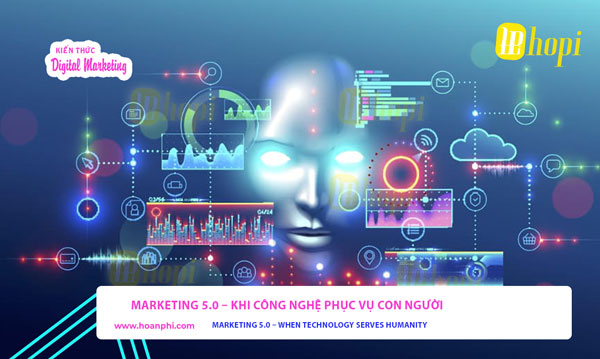
What is Marketing 5.0 and why is it important?
Marketing 5.0, as defined by Philip Kotler in his book of the same name, is the “application of human-mimicking technologies (Next Tech) to create, communicate, deliver, and enhance value across the customer journey.” In essence, it is a harmonious combination of the power of technology and the subtlety and empathy of humans. If Marketing 4.0 focused on bringing businesses into the digital space, then Marketing 5.0 is the next step: using technology within that space to create meaningful interactions and deliver real value.
The advent of Marketing 5.0 is driven by three major challenges: generational divides (between Baby Boomers, Gen X, Y, Z, and Alpha), prosperity polarization (the wealth gap), and the digital divide (between technology advocates and skeptics). To address these challenges, marketing needs a new approach that both leverages the power of data and technology and does not lose the human element. The importance of Marketing 5.0 lies in its ability to solve this problem.
The structure of Marketing 5.0 consists of five core components:
- Data-Driven Marketing: Collecting and analyzing Big Data from all touchpoints to build a single data ecosystem, which forms the basis for all marketing decisions.
- Predictive Marketing: Using artificial intelligence (AI) and machine learning to analyze past data, thereby predicting the outcomes of campaigns and future customer behavior.
- Contextual Marketing: Using sensors and digital interfaces to identify, analyze, and provide personalized interactions right at the customer's real time and place.
- Augmented Marketing: Applying technologies like chatbots and virtual assistants to enhance the efficiency of human marketers, helping them focus on tasks that require creativity and strategy.
- Agile Marketing: Applying agile principles to marketing operations, allowing teams to work in short, iterative cycles to quickly adapt to market changes.
What is the role of technology in Marketing 5.0?
Technology is the backbone of Marketing 5.0, but not just any technology. Kotler calls this group of technologies “Next Tech” – technologies that can emulate human intelligence and capabilities. They help automate, accelerate, personalize, and enrich the customer journey.
- Artificial Intelligence (AI): This is the foundational technology, allowing computers to learn from data and make intelligent decisions. In marketing, AI is used to personalize content, optimize advertising, analyze customer sentiment, and predict trends.
- Natural Language Processing (NLP): A branch of AI, NLP enables machines to understand and respond to human language. The most common applications are chatbots and virtual assistants, which provide 24/7 customer support naturally.
- Sensor Tech: Physical sensors like beacons, facial recognition, and proximity sensors collect data on customer behavior in the real world, forming the basis for contextual marketing.
- Robotics: Robots are increasingly used in customer-facing roles, from greeting at stores and providing product guidance to serving in restaurants, creating novel and efficient experiences.
- Augmented Reality (AR) and Virtual Reality (VR): AR and VR deliver immersive and interactive digital experiences. Customers can 'try' a piece of furniture in their home via AR or 'tour' a resort via VR before making a purchase.
- Internet of Things (IoT): Smart devices connected to each other form a vast network that continuously collects and exchanges data. IoT helps marketers understand customer product usage habits more deeply and provide proactive services.
What are the main differences between Marketing 4.0 and Marketing 5.0?
Although they may seem similar, Marketing 4.0 and 5.0 have fundamental differences in their objectives and methodology. Understanding this distinction helps businesses position their strategy correctly in the new context.
Marketing 4.0: Transitioning to Digital. The focus of Marketing 4.0 was the shift from traditional to digital marketing. It emphasized the importance of integrating online and offline interactions and building customer advocacy in the digital economy. The main goal was to guide customers from the Aware stage to the Advocate stage through digital channels. Marketing 4.0 is the foundation, the construction of a business's digital infrastructure.
Marketing 5.0: Applying Technology for Humanity. Meanwhile, Marketing 5.0 is built upon the foundation of 4.0. It is not a replacement but an evolution. The focus of 5.0 is the application of Next Tech (AI, NLP, IoT...) to enhance value across the entire digitized customer journey. If 4.0 was about building the digital road, then 5.0 is about equipping that road with smart vehicles, personalized directions, and superior experiences. The ultimate goal is to create a perfect balance between machine and human, where technology frees marketers from repetitive tasks so they can focus on strategy and creativity, bringing the empathy that machines cannot provide.
Simply put, the difference lies in the level of technology application. Marketing 4.0 uses technology as a channel, while Marketing 5.0 uses technology as an intelligent partner.
How can businesses apply Marketing 5.0 effectively?
Transitioning to Marketing 5.0 is not something that can be done overnight. It requires a strategic roadmap and commitment from the entire organization. Here are the basic steps for businesses to get started:
- Build a Solid Data Foundation: Everything in Marketing 5.0 starts with data. Businesses need to invest in systems like CRM (Customer Relationship Management), DMP (Data Management Platform), and CDP (Customer Data Platform) to collect, unify, and analyze data from all sources. The goal is to get a 360-degree view of the customer.
- Adopt an Agile Marketing Approach: The market is constantly changing, so marketing teams need to be flexible. Instead of annual planning, break down projects into short phases (sprints), and continuously test, measure, learn, and optimize. This helps minimize risk and increases reaction speed.
- Start with Predictive Marketing: Businesses can begin applying AI by building simple predictive models, such as predicting customer churn or identifying high-potential leads. This helps optimize resources and increase campaign effectiveness.
- Enhance Experiences with Contextual Marketing: Use real-time data to deliver messages and offers that are relevant to the customer's context. For example, sending a push notification about a promotion when a customer is near the store, or displaying ads for related products right after they search for information.
- Invest in People: Technology is just a tool. To succeed with Marketing 5.0, businesses must invest in training and upskilling their marketing teams. They need to become individuals who are both tech-savvy and capable of data analysis and strategic thinking, while maintaining creativity and empathy.
Conclusion
Marketing 5.0 is not a distant vision but a gradually emerging reality. It represents a paradigm shift where technology does not replace humans but becomes a powerful partner. By combining the analytical power of machines with the emotional intelligence of humans, businesses can create customer experiences that are not only smart and personalized but also deeply human. The future of marketing belongs to those who know how to use technology to best serve humanity.


Để lại bình luận
Bình luận & Phản hồi
Đang tải bình luận...