


A deep dive into Philip Kotler's 5A customer journey model in the context of Digital Marketing 4.0. Learn how to apply it effectively to attract customers and turn them into loyal brand advocates.
In the digital age, where all information is at our fingertips, the customer journey has become more complex and multi-dimensional than ever. Traditional marketing funnel models seem no longer sufficient to capture the dynamics of the modern consumer. This is where the 5A Customer Journey model by Philip Kotler, the father of modern marketing, shines as a guiding star for businesses in the context of Digital Marketing 4.0.
What is Philip Kotler's 5A model?
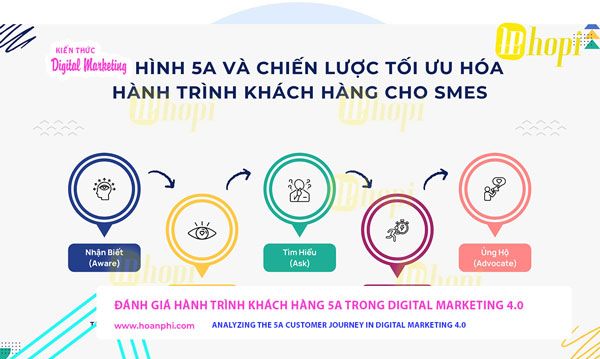
The 5A model is a framework describing the customer journey in the connected era, introduced in the book "Marketing 4.0: Moving from Traditional to Digital". It is no longer a linear funnel but a flexible loop, accurately reflecting how customers interact with brands through online and offline channels. 5A stands for the five main stages:
- Aware: This is the first stage where customers are passively exposed to a brand. They might learn about you through advertising, a friend's recommendation, or by chance on social media. This is the "I know about this product/brand" touchpoint.
- Appeal: After becoming aware, customers begin to process the message and feel attracted to certain brands. This stage is highly emotional. What makes your brand special enough for them to remember among thousands of other options?
- Ask: Once attracted, the customer's curiosity arises. They will actively seek more information. They read reviews, compare prices, ask friends, search on Google, and join forums. This stage emphasizes the role of community and external information sources.
- Act: After gathering enough information and being convinced, the customer decides to act. Action here is not limited to making a purchase but also includes usage, service experience, and post-purchase interaction.
- Advocate: This is the ultimate and most important goal. If they have a positive experience, customers will develop loyalty, make repeat purchases, and more importantly, become enthusiastic advocates. They proactively recommend your brand to others, creating a feedback loop back to the Aware stage for new customers.
Why is the 5A customer journey important in Digital Marketing 4.0?
The world of marketing has changed. Digital Marketing 4.0 is not just about digital tools; it's about a deep understanding of how people connect and make decisions. The 5A model becomes crucial for the following reasons:
- The rise of community: The "Ask" and "Advocate" stages emphasize that the voice of the community (friends, family, influencers, online reviews) now carries more weight than corporate advertising. Customers trust other people more than they trust brands.
- The journey is no longer linear: A customer might skip the Appeal stage and go straight to Ask if recommended by a trusted friend. Or they might return to the Ask stage multiple times before they Act. The 5A model is more flexible in describing these complex paths.
- Focus on advocacy, not just purchase: The ultimate goal is not to sell a product, but to create an advocate. An advocate is far more valuable than a single customer because they bring in new customers at no marketing cost. This is the essence of sustainable digital marketing.
How should businesses apply the 5A model in their strategy?
To successfully apply the 5A model, businesses need a tailored approach for each stage, leveraging the power of digital channels:
- Optimize the Aware stage: The goal is to create widespread presence. Use a combination of SEO (Search Engine Optimization) to appear on the first page of Google, paid advertising (Google Ads, Social Ads) to reach the right audience, and content marketing (blogs, videos, infographics) to provide value and capture initial attention.
- Build attraction in the Appeal stage: Your content must be unique and emotionally resonant. Build a compelling brand story, invest in high-quality images and videos, and communicate a clear Unique Value Proposition (UVP). Answer the question: "Why should customers choose us?"
- Facilitate and support the Ask stage: Make information seeking easy and transparent. Build a website with comprehensive product information, a detailed FAQ section, and integrate chatbots for quick answers. Most importantly, encourage and display customer reviews and successful case studies. This is the most powerful social proof.
- Simplify the Act stage: The user experience (UX/UI) on your website/app must be seamless. The checkout process needs to be simple, fast, and offer multiple options. Calls-to-Action (CTAs) must be clear and prominent. Any friction in the purchasing process can cause you to lose customers.
- Nurture advocates in the Advocate stage: The post-purchase experience determines loyalty. Provide excellent customer service, implement loyalty programs, and create communities (Facebook groups, forums) for customers to connect. Encourage them to share their experiences and make them a part of the brand story.
What is the main difference between the 5A model and traditional models (like AIDA)?
The AIDA model (Attention, Interest, Desire, Action) is a linear funnel where customers move from top to bottom, ending at the action of purchasing. In contrast, the 5A model is more cyclical and network-oriented.
The core difference lies in the Advocate stage. In AIDA, the journey ends when the customer makes a purchase. But in 5A, that is the starting point for a new loop. An advocate will create awareness and appeal for others, helping the business acquire new customers at almost zero cost. The 5A model recognizes the immense power of word-of-mouth marketing in the digital age.
Where is the future of the customer journey heading with the rise of Marketing 5.0?
If Marketing 4.0 was about digital transformation, then Marketing 5.0 is about "Technology for Humanity." The 5A customer journey will continue to be reinforced and enhanced by emerging technologies. Artificial Intelligence (AI) and Machine Learning will help personalize the experience at each stage more profoundly. Big Data will help businesses predict customer behavior in the Ask and Act stages. Virtual and Augmented Reality (VR/AR) can make the Appeal and Act stages more vivid and engaging than ever before.
However, the core of 5A remains unchanged: putting humans at the center. Technology is merely a tool to better understand and serve customers, to build authentic connections, and to turn them into loyal advocates. The businesses that master the essence of the 5A journey and skillfully apply technology will be the winners in the race for customers' hearts and minds.
Conclusion: The 5A model is not just a marketing theory; it is a practical map for businesses wanting to navigate the complex digital environment successfully. By focusing on creating appeal, supporting the inquiry process, simplifying action, and nurturing advocacy, you not only sell products but also build the most valuable asset: a community of loyal and passionate customers.


Để lại bình luận
Bình luận & Phản hồi
Đang tải bình luận...