


A detailed guide to the most traditional prayer for the first day of Tet, including offerings and important notes for a peaceful and lucky new year.
The first day of Tet (Mùng 1), the first day of the Lunar New Year, is the most sacred and important moment in Vietnamese culture. It is not only a time for family gatherings and exchanging best wishes but also an occasion for descendants to express their reverence and gratitude to ancestors and deities who have protected them throughout the past year. The worship ceremony on the first day of Tet, especially the votive prayer, is the spiritual thread that fully embodies the moral principle of "When drinking water, remember the source." A solemn, standard prayer not only brings peace of mind to the homeowner but also serves as a wish for a new year of peace, prosperity, and success.
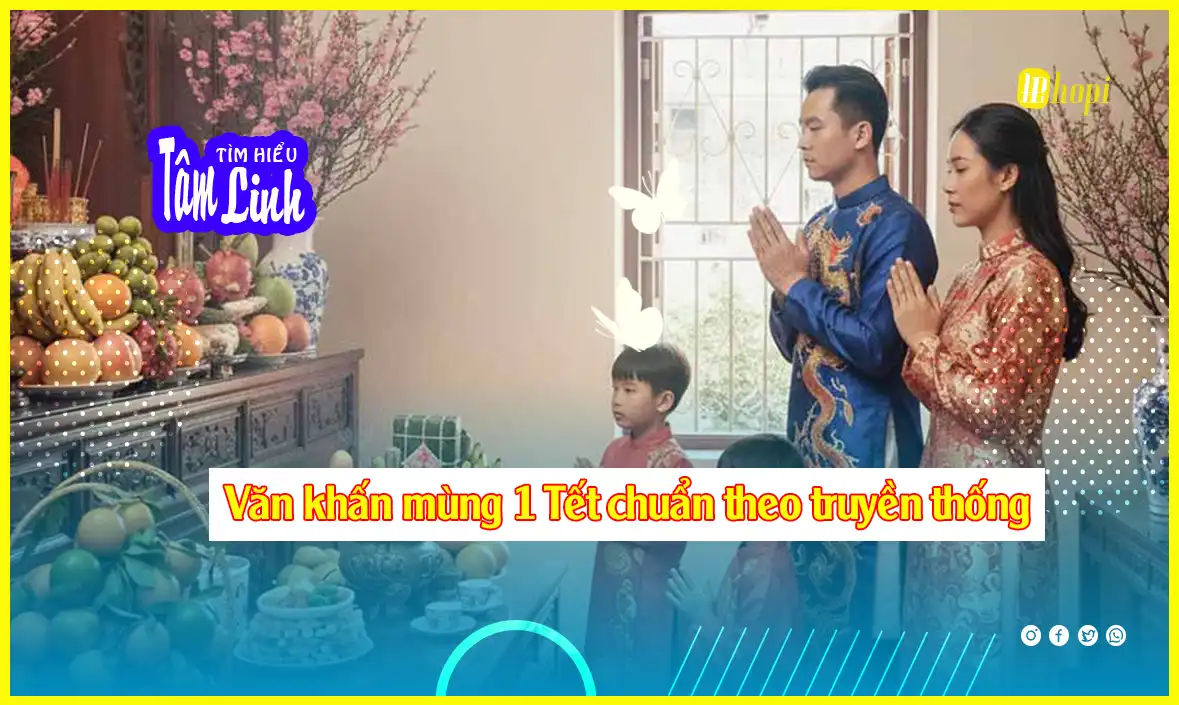
When is the best time to perform the Mung 1 Tet worship?
Choosing the time for the Mung 1 Tet worship is significant for ushering in a new year full of luck. Traditionally, this ceremony is often conducted on the early morning of the 1st day, after the New Year's Eve (Giao Thừa) ceremony. The most ideal time is during the auspicious hours of the first day of the year. The head of the household can consult a perpetual calendar to choose a favorable time frame that suits their age, usually during hours like the Dragon hour (7-9 AM) or the Snake hour (9-11 AM).
However, the most important thing is not the exact minute, but the solemnity and sincerity of the whole family. The ceremony should be performed when the family is well-dressed, gathered together, and the atmosphere is solemn and pure. This is the moment when everyone turns to the ancestral altar, offers fragrant incense, and sincerely prays for a smooth and favorable new beginning.
What offerings are needed for the Mung 1 Tet worship?
The offering tray for Mung 1 Tet does not need to be overly extravagant, but it must be complete and tidy, showing the thoughtfulness and sincerity of the descendants. Depending on economic conditions and regional customs, the offerings may vary, but they basically include the following items:
- Incense and Flowers: Incense sticks, candles, fresh flowers (usually chrysanthemums, gladioli, peach blossoms, or apricot blossoms), betel leaves and areca nuts, wine, tea, and clean water. These are indispensable items on any altar, signifying purity and solemnity.
- Five-Fruit Tray: An arrangement of five different types of fruit, symbolizing the five elements and the wish for "Prosperity - Wealth - Longevity - Health - Peace." The choice and arrangement of the five-fruit tray differ among the three regions, but they all share a common good meaning.
- Votive Paper: Votive money, clothes, hats... made of paper to be offered to deities and ancestors.
- Offering Feast: This can be a savory or vegetarian feast depending on family tradition. Preparing the offering feast for the beginning of the year is always a beautiful tradition, whether it is for the upcoming Year of the Fire Horse 2026 or any other year.
- Savory Feast: Usually includes traditional Tet dishes such as: square/cylindrical sticky rice cake (bánh chưng/bánh tét), a whole boiled chicken, Vietnamese sausage (giò lụa/chả quế), fried spring rolls, bamboo shoot soup with vermicelli, red sticky rice, salad... Each dish carries its own meaning, representing warmth and abundance.
- Vegetarian Feast: If the family is Buddhist or has a custom of eating vegetarian at the beginning of the year, the vegetarian feast will consist of dishes exquisitely prepared from vegetables, tofu, mushrooms... also beautifully and solemnly arranged.
What is the most standard prayer for ancestors and deities on Mung 1 Tet?
This is the most crucial part of the ceremony. The head of the household (usually the eldest person or the family head) should bathe, dress formally, light the incense, and sincerely recite the prayer aloud and clearly. Below is the most complete and solemn traditional prayer for Mung 1 Tet for your reference:
Namo Amitabha Buddha! (3 times)
We respectfully bow to:
- The Future Maitreya Buddha.
- The respected Deities who govern this land.
Today is the 1st day of the first lunar month, on the occasion of the Lunar New Year.
I, the devotee(s), am/are: ..................................................... Residing at: ............................................................................
Together with my entire family, we sincerely pay homage:
- To our Great-Great-Grandfathers, Great-Great-Grandmothers, uncles, brothers, aunts, sisters, and all spirits of the paternal and maternal lineage.
On the occasion of the new year, the first month, the first day, the first hour. I, the devotee, along with my entire family and descendants, have prepared offerings, incense, flowers, tea, and fruit, lighting these sincere incense sticks, and presenting them before the altar.
We sincerely invite:
- The respected Deities who govern this area.
- Our Ancestors, both paternal and maternal, Grandfathers, Grandmothers, parents, siblings, aunts, and uncles, and all the deceased members of our lineage (specific names can be mentioned if remembered).
We humbly ask you to have mercy on your descendants, to descend before this altar, witness our sincerity, and accept these offerings.
The old year has passed, the new year has arrived. We thank you all for protecting our family and granting us good fortune throughout the past year. As we step into the new year, we sincerely pray:
- We pray to the Deities to grant our family a new year of peace, prosperity, abundant health, and all our wishes to come true.
- We pray to our Ancestors to protect and guide the descendants of the family to achieve academic progress, a brilliant career, a prosperous family line, and harmony among all.
With our humble offerings and sincere hearts, we bow before the altar, humbly asking for your blessing and protection.
Namo Amitabha Buddha! (3 times)
What should be noted when performing the Mung 1 Tet ceremony?
For the ceremony to be solemn and meaningful, the head of the household should pay attention to the following points:
- Sincerity is key: The most important thing is not a lavish feast, but the sincerity and reverence of the descendants. Before the worship, all family members should maintain a calm and pure mind, avoiding arguments and loud voices.
- Formal attire: The person performing the ceremony and the participating members should wear clean, tidy, and formal clothes to show respect for the deities and ancestors.
- Clean the worship space: The altar must be cleaned and tidied before New Year's Eve. The items on the altar must be arranged neatly and in their proper places.
- Recite the prayer clearly: When reciting the prayer, the head of the household should speak at a moderate pace, loudly, clearly, and coherently to express solemnity and allow other members to listen and pray along sincerely.
- Lowering the offerings correctly: After the incense has burned down (about 2/3 of the stick), the head of the household can ask for permission to lower the offerings. The votive paper is burned in a clean, solemn place. The offering wine is sprinkled over the ashes after burning. The food from the feast is then shared by the family, which is called "receiving blessings" for the new year. Maintaining this ritual through the years, from now until Tet 2029, is the best way to preserve the culture.
Are there regional differences in Mung 1 Tet prayers?
Fundamentally, the content of the Mung 1 Tet prayer across Vietnam follows a similar structure: the beginning part pays respect to Buddhas and Deities; the middle part invites the ancestors; and the final part is for prayers and gratitude. The differences, if any, are usually minor and lie in small details:
- Names of Deities: Some localities may add the names of the village's Tutelary God, the Land Genie, or other local deities specific to their region.
- Accompanying Offerings: As mentioned above, the feast and the five-fruit tray have unique characteristics in the North, Central, and South regions, and this is sometimes symbolically mentioned in the prayer.
- Local Dialect: The tone and some words may carry a local flavor, but the overall meaning remains the same.
However, the prayer introduced above is the most common and widely accepted version, suitable for use in all regions. The core essence is that the reverence and sincerity of the person praying are always the decisive factors in the value of the ceremony.
The worship ceremony and prayer on the first day of Tet are a profound spiritual and cultural beauty, marking the beginning of a new year with faith and hope. Performing the ritual in a solemn and thoughtful manner is not only to pray for good fortune for the family but also a way to educate future generations about gratitude and ancestral traditions. We wish you a warm, complete, and prosperous New Year ceremony and a peaceful new year!


Để lại bình luận
Bình luận & Phản hồi
Đang tải bình luận...