


The most complete and standard Year-End prayer guide. Detailed instructions on offerings, significance, and important notes for a prosperous and peaceful New Year.
Tat Nien, two endearing words that resonate every time Tet arrives, is one of the most important and meaningful rituals in the traditional culture of the Vietnamese people. It is not just the last family meal of the old year but also an occasion for each family to express their reverence for heaven and earth, deities, and ancestors, to look back on the past year, and to pray for a peaceful and happy new year. This article will serve as a comprehensive guide to help you better understand the meaning and how to perform the Tat Nien ceremony in the most solemn and traditional way.
What is the Tat Nien Ceremony and What is its Significance?
"Tất" means 'end', and "niên" means 'year'. Tat Nien is a ceremony marking the end of an old year and preparing to step into a new one. In essence, it is a ritual to report to the Kitchen God, the household deities, and the ancestors about what the family has accomplished over the past year, while also giving thanks for their protection that helped the family have a peaceful year, despite any difficulties and challenges.
The significance of the Tat Nien ceremony is profound:
- Spiritual Meaning: It is an occasion for descendants to show gratitude and filial piety to their ancestors and the deceased. The ceremony is an invisible thread connecting the worlds of the living and the dead, inviting ancestors to return home to celebrate Tet with their descendants in a warm family atmosphere.
- Family Meaning: The Tat Nien ceremony is a precious moment for family members, no matter how far away they work, to try to return for a reunion over the year's final meal. Everyone gathers to chat, share stories of the past year, resolve misunderstandings, and look forward to a better new year together.
- Social Meaning: Tat Nien is not only confined to the family but is also organized in companies and organizations. It's an occasion to summarize the year's activities, show appreciation for employees' contributions, and strengthen collective solidarity.
What is the Best Day and Time to Perform the Tat Nien Ceremony?
According to ancient customs, the Tat Nien ceremony is usually conducted on the last day of the lunar year, which is the 30th day of the 12th lunar month (or the 29th if it's a shorter month). This is considered the most sacred time, the boundary between the old year and the new.
However, in today's busy modern life, many families have become more flexible, organizing the Tat Nien ceremony earlier. The ceremony can be performed on any day within the last 10 days of the 12th lunar month, usually from after the Kitchen Gods' Day (23rd of the 12th month) until the afternoon of the 30th of Tet. The most important thing is sincerity and convenient arrangement so that all family members can attend.
As for the time of the ceremony, families often choose to perform it at noon or in the evening. The evening is more popular because after the ceremony, the whole family can gather to enjoy the Tat Nien meal in a cozy and complete atmosphere.
What Should Be Prepared for the Year-End Offering Tray?
There is no rigid standard for the Tat Nien offering tray; it depends on the economic conditions and customs of each region. However, the tray is always prepared meticulously and abundantly, showing the host's sincerity. Preparing for Tat Nien is not just for this year but is a continuation of tradition for future generations, so that whether it's Tet 2033 or even further, descendants will remember their roots. This tradition is as strong as the spirit of the Year of the Fire Horse 2026, always looking forward but never forgetting the past. Basically, an offering tray will include:
- Incense and Flowers: Incense sticks, candles, fresh flowers (usually chrysanthemums, gladiolus), betel leaves and areca nuts.
- Five-Fruit Tray (Mâm Ngũ Quả): An arrangement of 5 different types of fruit with various colors, symbolizing the Five Elements and wishes for fullness and prosperity.
- Votive paper money.
- Wine, tea, and plain water.
- Savory Dishes: Elaborately prepared and beautifully presented dishes.
The offering tray has distinct features in each region:
- The North: The tray often includes 4 bowls and 4 plates (symbolizing the four pillars, four seasons). Typical dishes include boiled chicken, Banh Chung (square sticky rice cake), Gio Lua (pork sausage), Gio Xao (head cheese), Nem Ran (fried spring rolls), bamboo shoot and vermicelli soup, salad, and pickled onions.
- The Center: The offerings are often divided into small plates, reflecting frugality and refinement. Popular dishes include Banh Tet (cylindrical sticky rice cake), Nem Chua (fermented pork), Tre, Gio Bo (beef sausage), pork soaked in fish sauce, sour shrimp, and various rolls.
- The South: The tray is often richer and more diverse, with a sweeter flavor profile. Indispensable dishes include Banh Tet with pickled leeks, caramelized pork and eggs (Thit Kho Tau), bitter melon soup stuffed with meat, salads, and Cha Gio (fried spring rolls).
The Most Complete and Standard Year-End Prayer
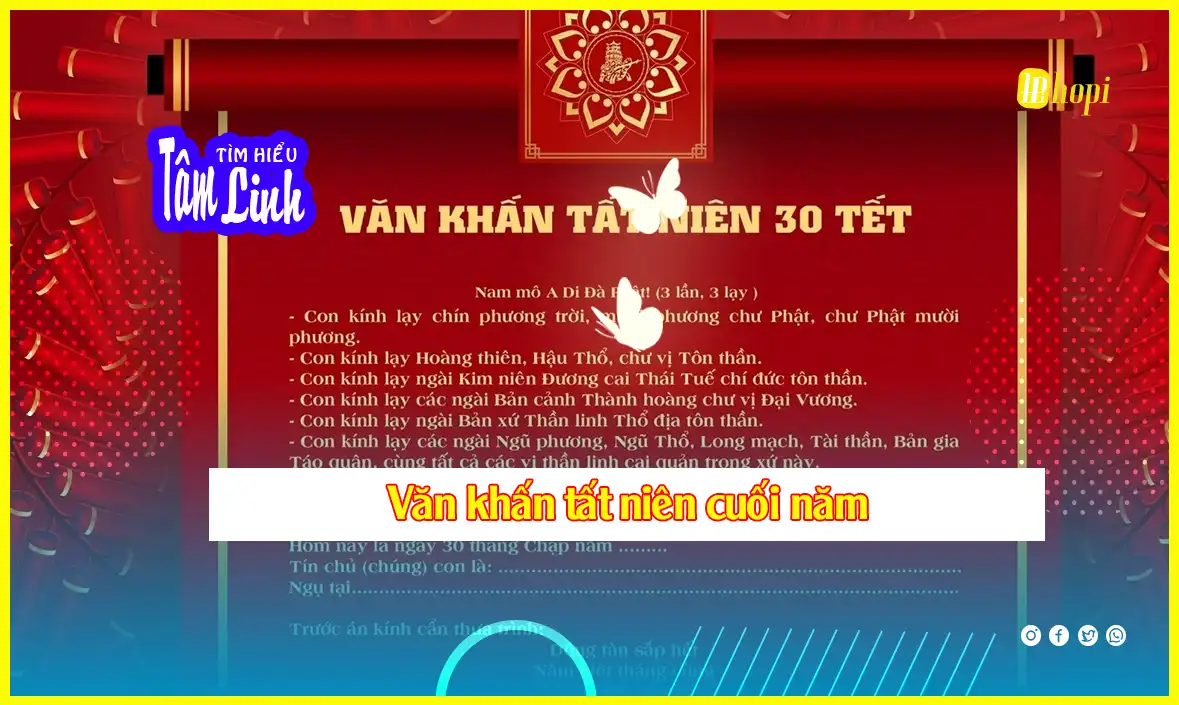
This is the most important part of the ceremony. The head of the household (usually the eldest person) will dress formally, light incense, and devoutly recite the prayer. The prayer is often divided into two parts: one for the Deities and one for the Ancestors. Below is a complete and formal prayer text you can refer to:
(The householder lights incense, bows three times, then recites clearly and loudly)
Namo Amitabha Buddha! (3 times)
I pay homage to the nine directions of Heaven, the ten directions of Buddhas, the Buddhas of the ten directions.
I pay homage to the Maitreya Buddha.
I pay homage to the Heavenly Emperors, the Earth Spirits, and the venerable Deities.
I pay homage to the Year's Grand Duke, the Virtuous and Venerable Deity.
I pay homage to the Tutelary Gods and the Great Kings of this land.
I pay homage to the Land God and the local Earth Spirits.
I pay homage to the Deities of the Five Directions, Five Lands, the Dragon Veins, the God of Wealth, the Kitchen God, and all venerable Deities.
I pay homage to all the guardian spirits of this place.
Today is the ..... day of the 12th month of the year ..... (Lunar calendar)
Your devotee(s), I/we am/are: ............................................
Residing at: .........................................................................
Before the altar, we sincerely prepare incense, flowers, offerings, gold paper, tea, and fruits, presenting them before you. We respectfully invite the Year's Grand Duke, the Tutelary Gods, the Land God, the Kitchen God, the Deities of the Five Directions, Five Lands, the Dragon Veins, the God of Wealth, and all the guardian spirits of this area.
We humbly ask the sacred spirits to descend before this altar, receive our offerings, and witness our sincere hearts.
An old year has passed. We offer this ceremony to thank all the Deities who have always protected and blessed our family with peace, smooth work, and good health. For anything that was not as we wished, we bow in repentance and ask for your forgiveness.
Now, on the occasion of the year's end and the coming of Tet, we prepare this Tat Nien ceremony to respectfully report to you, to bid farewell to the old year, and to welcome the new one.
We pray that you continue to bless and support our entire family in the new year with prosperity, all wishes fulfilled, a thriving family, harmonious children, and successful endeavors.
With our humble offerings and sincere hearts, we bow before you and pray for your protection and guidance.
Namo Amitabha Buddha! (3 times)
--- (After praying to the Deities, the householder continues to pray to the Ancestors) ---
Namo Amitabha Buddha! (3 times)
I pay homage to our forefathers and foremothers, and the ancestral spirits of both paternal and maternal lines.
I pay homage to the female ancestors, male ancestors, and the souls of our late predecessors of the ............ family.
Today is the ..... day of the 12th month of the year ..... (Lunar calendar)
Your devotee(s), I/we am/are: ............................................
Residing at: .........................................................................
On this year-end occasion, we, along with all descendants of the family, remember the immense gratitude we owe our ancestors, never forgetting our roots. We sincerely prepare offerings, incense, flowers, tea, fruits, votive papers, and a full feast to present before the altar.
We respectfully invite: Our forefathers, foremothers, all ancestral spirits, female and male ancestors, and the souls of our late predecessors from both paternal and maternal sides. We humbly ask you to have mercy on your descendants, descend to this altar, witness our sincere hearts, and receive our offerings.
We report that the old year has passed. Thanks to the blessings of our ancestors, our family has been safe and sound. Now, as the year ends and Tet arrives, we invite you to reunite with us, your descendants, to celebrate Tet and welcome the spring.
We pray for our ancestors' blessing and support for our entire family to have a prosperous new year, a home full of fortune and blessings, filial children, academic success, and glorious careers.
With our humble offerings and sincere hearts, we bow before you and pray for your protection and guidance.
Namo Amitabha Buddha! (3 times)
What Are the Important Things to Note When Performing the Tat Nien Ceremony?
To ensure the ceremony is solemn and meaningful, you should pay attention to the following:
- Clean the house and altar: Before the ceremony, the house should be cleaned and tidy. The ancestral altar must be carefully cleaned and beautifully decorated to show respect.
- Prepare offerings carefully: The offerings and dishes should be prepared neatly and cleanly. Fruits and flowers must be fresh, not artificial.
- Dress respectfully: When conducting the ceremony, all family members should wear clean, tidy, and respectful clothing to show solemnity.
- Maintain a sincere attitude: The most important thing is not the lavishness of the feast but the sincere hearts of the descendants. When praying, one should speak clearly, focus their thoughts, and pray earnestly.
- After the ceremony: After the incense has burned down (about 2/3 of the stick), the householder bows in thanks, burns the votive papers, and asks for permission to take down the offerings. The whole family then gathers to enjoy the Tat Nien meal in a joyful and warm atmosphere.
The Tat Nien ceremony is not just a beautiful cultural tradition but also a priceless spiritual value that helps connect generations within a family. Hopefully, through this article, you will gain useful knowledge to prepare a cozy, solemn, and meaningful Tat Nien ceremony, closing an old year and welcoming a new one with much joy and luck.


Để lại bình luận
Bình luận & Phản hồi
Đang tải bình luận...