


Discover the correct order of Tet worship ceremonies, from the Kitchen Gods' farewell to the Gold Burning ritual. A detailed guide for a complete and traditional celebration.
The Lunar New Year, or Tet, is not just a moment of transition between the old and new year, but also an occasion for descendants to express their respect and gratitude to ancestors and deities. Worship ceremonies during Tet are an indispensable part of Vietnamese spiritual culture, carrying the meaning of praying for a new year of peace, luck, and prosperity. However, in the modern pace of life, not everyone is clear about the order and significance of each ceremony. This article will serve as a detailed guide to help you perform these rituals in the most solemn and correct order.
What is the significance of the Kitchen Gods ceremony and when is it held?
The ceremony for the Kitchen Gods (Ông Công Ông Táo) is the first ritual, kicking off the series of activities to welcome Tet. It is one of the oldest and most important folk beliefs of the Vietnamese people.
Significance of the ceremony:
According to folk belief, Ông Công is the deity who governs the land of the household, while Ông Táo (consisting of two male gods and one female goddess) are the deities who oversee the kitchen and record the good and bad deeds of family members. On the 23rd day of the 12th lunar month each year, these deities ride carps to heaven to report all the family's affairs of the past year to the Jade Emperor. Based on this report, the Jade Emperor will decide the family's fortune or punishment for the new year. Therefore, the Kitchen Gods ceremony is performed with the hope that the deities will "speak well" of the family, praying for a new year of peace and prosperity.
Time and offerings:
-
Time: The ceremony is usually held on the 23rd day of the 12th lunar month. Families can perform it in the morning or at noon, but it must be completed before 12 PM so the Kitchen Gods have time to ascend to heaven.
-
Offerings: The offering tray usually includes traditional savory dishes such as boiled chicken, sticky rice, Vietnamese sausage, and bamboo shoot soup. Besides, characteristic offerings are indispensable:
-
Carps: This is the "vehicle" for the Kitchen Gods to travel to heaven. People often offer three live carps, which are released into a river or lake after the ceremony, symbolizing the "carp transforming into a dragon," representing promotion and good fortune.
-
Kitchen Gods' attire set: This includes three sets of hats, robes, and shoes made of paper (two for males and one for a female), along with votive money. After the ceremony, these items are burned to be sent to the deities.
-
Preparing a well-appointed offering tray not only shows sincerity but also marks the beginning of a warm and abundant Tet season.
When is the most appropriate time to organize the Year-End ceremony?
After sending off the Kitchen Gods, families begin cleaning their houses, shopping, and preparing for the Year-End ceremony (Tất niên). This is an important ritual, signifying reunion and the conclusion of the old year.
Significance of the Year-End ceremony:
Tất niên means "the end of a year." The Year-End meal is an opportunity for the whole family to gather after a year of hard work, to look back on what has passed and look forward to a better new year. Spiritually, this is a ceremony to invite ancestors to come home and celebrate Tet with their descendants. The offering tray is placed solemnly on the ancestral altar, expressing the descendants' gratitude for the ancestors' protection throughout the year.
Time and organization:
-
Time: The Year-End ceremony is usually held on the afternoon or evening of the 30th of Tet (or the 29th if it's a shorter month). This is when family members have finished their work and returned home for the reunion.
-
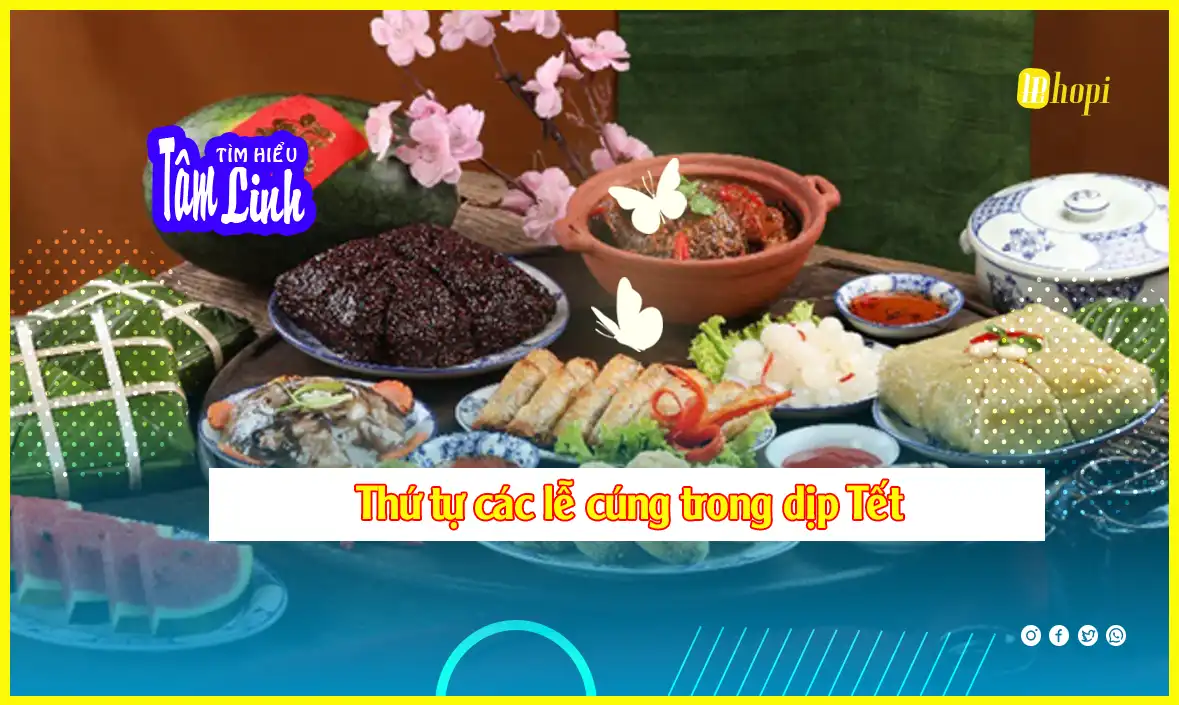
The Year-End feast: The offering feast for Tất niên typically includes the most delicious and characteristic Tet dishes such as Chung cake, Tet cake, boiled chicken, fried spring rolls, pork sausage, bamboo shoot soup, and red sticky rice. The more abundant and well-presented the feast, the more it shows sincerity and the wish for a prosperous new year. After the incense has burned out, the family will take down the offerings and enjoy the warm reunion meal, filled with laughter.
The Year-End ceremony is not only a religious ritual but also a beautiful cultural feature that strengthens family bonds, creating a sacred and warm atmosphere on the eve of the new year.
How do the indoor and outdoor New Year's Eve ceremonies differ?
New Year's Eve (Giao thừa) is the most sacred moment of the Tet holiday, the point of transition between the old year and the new, between heaven and earth. The New Year's Eve worship ceremony thus holds a very special meaning and is performed both indoors and outdoors.
Significance of the New Year's Eve ceremony:
According to folk belief, each year a different Mandarin (Quan Hành Khiển) is in charge of the mortal world. The New Year's Eve ceremony is to "bid farewell to the old and welcome the new" – to see off the old Mandarin and welcome the new one. The outdoor ceremony is to worship the celestial soldiers and generals accompanying the Mandarin. The indoor ceremony is to invite ancestors to join in the celebration and welcome the new year with their descendants.
The difference between the two ceremonies:
-
Outdoor ceremony (Worship of Heaven and Earth):
-
Location: The offering table is placed in front of the house or on the rooftop.
-
Time: It must be conducted exactly at the Hour of the Rat (from 11 PM to 1 AM), at the very moment of the transition.
-
Offerings: Usually simpler than the indoor feast, including a boiled chicken, sticky rice, Chung cake, fruits, betel leaves and areca nuts, wine, tea, and votive paper. The chicken for this ceremony is often a rooster, symbolizing the strength and purity of the new year's dawn.
-
-
Indoor ceremony (Worship of Ancestors):
-
Location: Performed at the ancestral altar.
-
Time: Immediately after completing the outdoor ceremony.
-
Offerings: A full feast with Tet dishes, similar to the Year-End feast but with freshly cooked food. This is the first meal of the new year offered to the ancestors, showing filial piety and the hope for their blessings.
-
Performing both ceremonies concurrently demonstrates the harmony in Vietnamese beliefs: respecting the deities governing heaven and earth while never forgetting one's roots and ancestors.
On the 1st day of Tet, what time and what should be offered to ancestors?
The first day of Tet is the beginning of the new year, carrying hopes for fresh and auspicious starts. The ancestor worship ceremony on this day is to invite the ancestors to have the first meal of the year and to pray for a year of peace and prosperity.
Significance of the 1st day ceremony:
This ceremony is also known as "Chính đán." It is a way for descendants to show their respect, inviting ancestors to "celebrate Tet" and witness the family's sincerity. It is believed that if the first day of the year goes smoothly and solemnly, the entire year will be filled with good luck.
Time and offerings:
-
Time: The ceremony is usually conducted in the morning or at noon on the 1st day of Tet. After visiting relatives for New Year wishes, the elders return home, and the family prepares a meal to offer to the ancestors.
-
Offerings: The offering feast on the 1st day usually consists of freshly prepared dishes, not leftovers from the 30th. The feast can be savory or vegetarian depending on the family's customs. The signature dishes are still Chung cake, boiled chicken, sausages, etc., representing abundance and fulfillment. During these days, the ancestral altar is always kept clean, with warm incense and lights, and fresh fruits and flowers.
On the 2nd and 3rd days, families continue to offer meals on the ancestral altar daily until the Gold Burning ceremony.
What is the Gold Burning ceremony and why is it important?
The Gold Burning ceremony (Lễ Hóa vàng), also known as the New Year's Thanksgiving ceremony, is the final ritual to conclude the series of spiritual activities during the Tet holiday.
Significance of the Gold Burning ceremony:
If the Year-End ceremony is to invite ancestors to celebrate Tet, the Gold Burning ceremony is to see them off back to the afterlife after days of reunion with their descendants. It is also an occasion for the family to thank the deities and ancestors for joining the celebration and protecting the family during the first days of the year. This ritual signifies a complete end to the Tet holidays and is a prayer for the ancestors to have an abundant life in the other world and continue to watch over and protect their descendants.
Time and ritual:
-
Time: The Gold Burning ceremony is often performed from the 3rd to the 10th day of the first lunar month, depending on the conditions and customs of each family. However, the most common day is the 3rd day of Tet.
-
Ritual: The head of the household prepares an offering feast, which can be savory or vegetarian, but it doesn't need to be as elaborate as in previous days. After lighting incense and praying, the family proceeds to burn the votive paper. All the votive money, clothes, and paper items offered during Tet are taken to a clean yard or a large urn to be burned. While burning, people often sprinkle a little wine into the flames with the belief that only then can the ancestors receive the offerings. After the burning is complete, the descendants will bow one last time to bid farewell, officially closing the Lunar New Year celebrations.
Understanding and correctly performing the sequence of worship ceremonies during Tet not only helps preserve beautiful cultural traditions but also brings peace of mind, starting a new year with much faith and hope. Hopefully, the information shared above will help your family have a complete and meaningful Tet, preparing for a prosperous new year. Wishing that the upcoming tết 2035 and năm bính ngọ 2026 will bring much wealth and luck to everyone.


Để lại bình luận
Bình luận & Phản hồi
Đang tải bình luận...